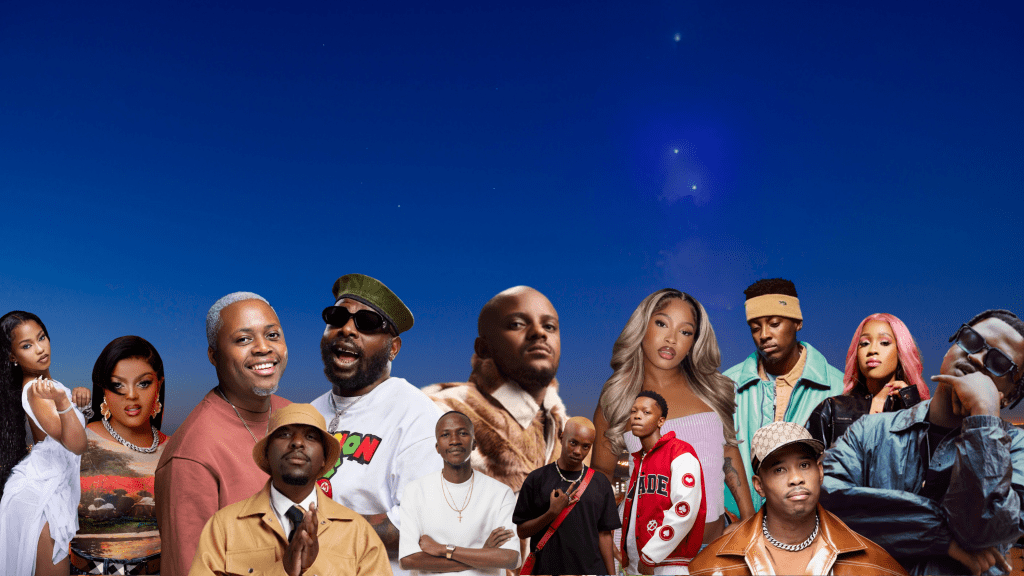
What’s a fitting continuation of the story of South African pop music culture? A genre that pays homage to two native sounds and brings them together into a new subgenre that takes over international soundwaves. The rise of Amapiano is an interesting case study, once a genre that brewed in the backyards of townships to a multi-million rand music economy.
In a way true to homegrown creations, Amapiano’s potential could not be placed within a box. I remember my first true encounter with Amapiano, before it was charting radio station airwaves back in 2019. I was in high school and we had just had an inter-house swimming gala and a group of grade 10s gathered to *discretely* use the school speakers to enjoy the last few minutes with it. I would never gather in a circle where people are dancing, I am painfully socially anxious [winning that battle though] so it’s important to point out that this opened circle came to where I was sitting, I did not follow it. One of the biggest songs of the Amapaino boom was playing: “Labantwana Ama Uber” (Semi Tea feat. Miano and Kammu Dee) and probably the most rhythmic dancer I had ever laid eyes on was glowing through the sound of what I was hearing, skillfully using her body to transport the music through her body, moving with a silkyness as though the music was water that she was swimming through. I knew South Africans can dance, I had a cousin who was a majaivane (colloquial term for dancer), but seeing a rhythmic exercise like this, witnessing that people can dance LIKE THIS to songs that sound THIS GOOD? This was a new dispensation, a discovery.
As someone who isn’t into dance culture, this new dance music sound appealed to me. The appeal was not necessarily in how it moved the people, it was in how the music gave me the right to think who I naturally am, and where I come from is cool. The effects of colonialism and oppression on the black psyche still raging on two decades after the end of Apartheid; the places where we come from, our natural expression, and our experiences and situations were termed “ghetto,” as a derogatory tool to shame our own kind, and all of us drank the Kool-Aid. There wasn’t anything “cool” about being from a township; the aspiration to wealth or the perception of it had crept into South Africa, and even in Primary School, we got teased and laughed at if you said you lived in or came from a township while attending an English & Afrikaans School (the so-called “better schools”). As if the failure to achieve upward economic mobility was a moral failure on the part of the previously disadvantaged. Anyway, Amapiano made real black culture cool again; it made us return to ourselves.
Characterized by a blend of deep house, kwaito, jazz, and lounge music, with original, distinctive percussion basslines known as “log drums”, Amapiano is a native South African genre owned and created by young black South Africans. Its pioneers include MFR Souls, MDU aka TRP, Kabza De Small, DJ Maphorisa, and Calvin Fallo, who are among the key influential figures who are consistently recognised as artists who helped define the genre. Most have described it as a confluence of Kwaito & House Music and is often categorised as a House subgenre. This is because the music sits on a bedrock of slowed house music while standing on kwaito-style singing and “rapping”.
Less than 10 years ago, South African streaming charts and radio charts were dominated by international artists; today, South African charts belong to Amapiano. Similar to Kwaito’s impact on the youth of the ’90s, Amapiano’s impact on today’s youth in South Africa is a tale of enormous stature. Not only is it a vehicle of positive self-image and a celebration of who we are, it’s evidence that we have it in us to take our country onto a giant leap of change into greatness. The global community’s nod to what we do and who we are should not be seen as validation for what we already know about ourselves, but it should serve as confirmation that the dream of our self-actualisation is not a far-fetched dream, that it is tangible and truly within reach. The “Amapiano to the world” campaign championed by the artists who make the music and all those who listen to and love the sound is a cultural evolution that young South Africans can use to set the standard for who we decide to become as we chase collective greatness.
When we see Uncle Waffles shine on international stages that now carry our sound and our stories, even though they were not created to, South African and Swati children are learning that it doesn’t serve anyone to shrink and not walk confidently into the dreams that once felt impossible. When the likes of Major League DJs and Focalistic build business relationships and collaborate with international acts to further the Amapiano Agenda, it sends a clear picture that South African youth know their worth and are commercially astute to build empires on strong business principles. When Kelvin Momo creates music of such elegant taste that it earns him a cult following of people who aren’t only music lovers but who consider themselves connoisseurs of the type of Amapiano he makes, we all collectively learn that Amapiano’s success isn’t only in how loud one can be about their art, but also about that quiet excellence that makes one great. When the likes of Mas Musiq, Mellow & Sleazy, DBN Gogo, Pabi Cooper, and Zee Nxumalo create hits with the kind of excellence that comes from the child-like joy of doing what you love, we learn that achieving greatness doesn’t have to be a draining exercise; it can be a freeing one. When guys like De Mthuda, MDU aka TRP & Stokie create blissful sounds quietly and through consistent hard work and trained talent, we learn that indeed one’s talent truly makes room for them in the presence of kings, and that talent speaks for itself. And finally when artists like Kabza de Small and DJ Maphorisa create with a type of genius and visionary essence that it empowers a generation, we learn that when special moments choose us, the kind of moments that move a culture forward and transform a nation, when those moments choose us, they remind us that we are capable of much more than we can fathom.
So the next time someone asks me why I love Amapiano so much, I’ll send them this blog post & say to them, Amapiano isn’t just dance music or dance culture, it’s the Sound of a version of South Africa that is ready to actualise the greatness that has always been inside it all this time.
To close off this week’s post, I’ve attached 10 of my most favourite amapiano song selections, enjoy. x and let me know what you top 10 Amapiano songs are in the comments.
10. Serurubele, MDU aka TRP
9. Wa Nsiya, Kelvin Momo & Stixx
8. Ingabe, Kabza De Small & Spartz
7. Endaweni Efudumele, Russell Zuma & George Lesley, Soultronixx, Juggernot SA
6. Ebumnandini, De Mthuda, Njelic, Mkeyz
5. Awukhuzeki, DJ Stokie, Zee_nhle, Omit ST, Sobzeen
4. Asibe Happy, Kabza de Small, DJ Maphorisa, Ami Faku
3. Wamuhle, Slade, Sino Msolo, Tweezy & Yumbs
2. Sengizwile, Mas Musiq, Aymos & Young Stunna
1 . Abalele, Kabza De Small, DJ Maphorisa, Ami Faku
 Muse Journal
Leave a comment