Muse Journal

Category: 2025

  • The Great South African Vibes: SA Pop Music Culture [In History] Part 1

    6–8 minutes

    I’ve always wanted to know what happened on day 1 of Post-Apartheid South Africa. What were the vibes like? What did the people get up to? Were the first few weeks of liberation a series of nationwide jubilation, or rather a huge sigh of relief to a nation that had carried a mountain of pain on its shoulders for so long? I haven’t seen any documented videos or stories on how South Africans adjusted to freedom in real time, in terms of how the freedom was processed and how it continued to live on the streets, within homes, and within hearts before the honeymoon phase wore off.

    To my delight, through following the story of music in our country, I’ve come to learn that the Black South African spirit was always free; we’ve always been a people of high spirits, carried by song, always singing truth to power and harnessing the magic of music to document moments, history, and revolutions. This blog post comes two days after Kwaito Star-Group Trompies released an amapiano-infused kwaito song featuring some of the most popular names in South African music culture today. The story of South Africa continues, and the music continues to give this history a belting voice.

    The history we reference begins in the post-1994 era, extending into the early 2000sβ€”one generation after the Bra Hugh Masekelas, Miriam Makebas, Letta Mbulus, and Brenda Fassies of our world. We turn the page to the young and free: those who gave a liberated South Africa a new cultural language.

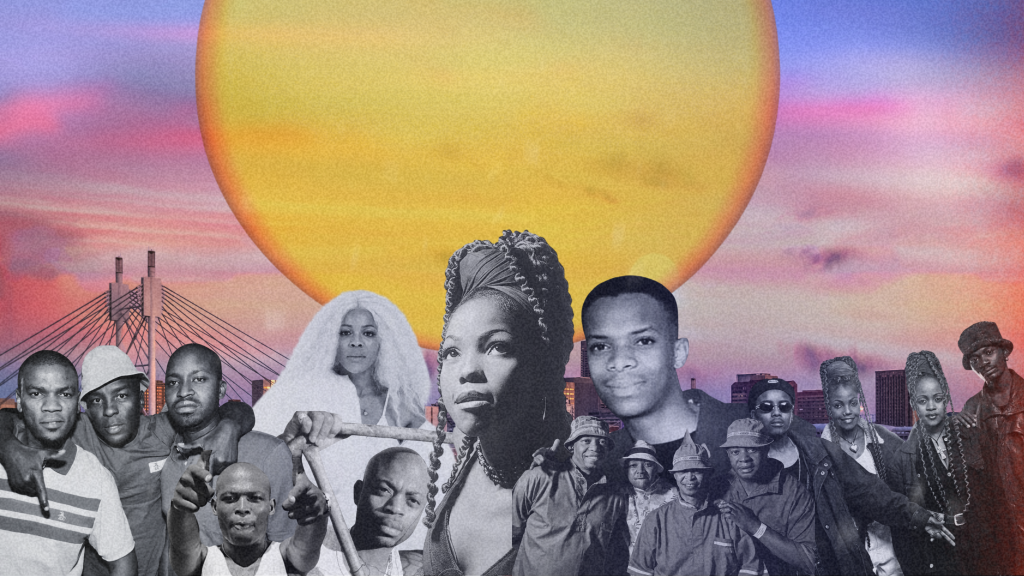
    When Boom Shaka released “Thobela” in 1996, it was our greeting to the world with our new identity. Boom Shaka was a group of youngstars at the time who were part of the early pioneers of Kwaito music, a genre described as the melting pot of different genres that include ‘Marabi’ of the 1920s, ‘Kwela’ of the 1950s, ‘Mbaqanga’ of the hostel dwellers and ‘Bubblegum’ music of the 80’s – a host of Old South African genres while including international influences through disco music, house, hip-hop, jazz and RnB. It’s an adaptive genre that pays ode to historical South African sounds but also charts a new path for who the youth of South Africa chose to be, now free & unrestricted in their expression.

    Our music remained largely political; even in the youthful Kwaito sound, we always sang for social impact. Enter the M’Dus and Trompies of Kwaito who would later influence the Brown Dashes, Mgarimbes and Thebes of South African music who sang about anything they wished to express; a true practise of and revolution into freedom. Who would have thought that the songs of the people would one day move from being about Uhuru and the yearning for freedom to being the very self-expression of and the real-time pleasures of the fruits of freedom that were fought for? M’Du’s Siya Jola (Ok’Salayo), released in 1998, marks a change of theme in South African popular music culture; this change led the way to music that was just about the day-to-day living of Black South Africans in the townships of the nation. The relaxed, colloquially charming, and culturally atuned kwaito lyrics in songs like these remain cultural pillars of the way black culture moved, what black South Africans used to say, and how they used to live. It started a preservation of heritage where the history of black people did not need to begin with pain; it could just be black joy.

    On the topic of black joy, the reason why the genre was named “Kwaito” was due to its totsitaal origins, the word “Kwaito” actually means hot-tempered/angry music, derived from the Afrikaans/tsotsitaal word “kwaai”, which is another significant factor to the genre. In one of Kwaito’s most romantic songs, Brown Dash’s Vum Vum is a declaration of love, a heart-to-heart kind of song if you will, but all of this is expressed in “tsotsi” -criminal “taal”- language which carries a certain roughness and violence, in ode to the “kwaai”(anger/hot-temperedness) it is meant to reflect. The sweetest, most fun song where your boyfriend is telling you he’ll one day drive you around in a car so you can get some fresh air [the act of driving around being a luxury for the people at the time], all of this charm and sweetness expressed in a way a nonchalant, love-vocabulary-deprived, survival mode South African man from the township would express it. So Kwaito wasn’t only a music expression of freedom or a preservation of black South African culture and language heritage, it was also a cultural mirror documenting all the quirks and hopes of South Africans at a personal and family level, an Arena where black South Africans got to engage outside of politics in an arena where they existed just as humans who simply loved, had material desires, craved some fresh air and wanted to just have fun.

    One classical Kwaito hit song, “Magasman” by Trompies, sits among the finest songs to ever come out of South Africa. This one particularly carries heavy jazz and RnB influences and sounds. When I think of the feeling one gets when listening to today’s Amapiano, it’s a replica of what one feels when listening to Magasman – just the most beautiful sound waves hitting your body, making you feel like you’re levitating or floating in some cool and fun sauce. This coolness and beauty in music is the essence of what makes South African music so different; it’s not only our phenomenal sense of rhythm, with songs that break structural rules of music playing onto the side of magic, but it is also the utter talent and excellence with which music is bred in Mzansi. Our music isn’t only fresh, revolutionary, and culture preserving, but it is also remarkably excellent. Trompies and many others who have made special music may not have received global acclaim and praise for their creations, but the rhythm and fusion of sounds speak of the rare and genius touch for music embodied by South African musical artists. The Apartheid government tried to dim this light when they realised Black and Coloured South Africans were making Jazz that sounds better than Western Jazz. The shadow-ban of black Jazz on government-approved TV and radio stations was meant to place black South Africans in a box to limit their capabilities. We can attest from the right side of history that the Apartheid government failed dismally in this attempt.

    This revolution of Black South African Music & pride in Black South African expression was championed and completed to come full circle with the creation of TKZee by Tokollo, Zwai and Kabelo, 3 young men at the time who were products of Model-C, private school education in New Johannesburg. Their contribution to Kwaito music, and it was an immense one at that, points to the full integration of black success in the new South Africa, where the Tokollos, Zwais, and Kabelos of the world could exist in white-dominated spaces in all their truth. In one of their many hit songs, “Dlala Mapantsula,” you can actually hear their wealth of experience in the two different environments they constantly had to code-switch between. On the one hand, you can hear, for example, the twang in their “Hello December, wassup” ad-lib intro, and on the other hand, you can hear how they are able to marry that with their fluency in Kasi living and Kasi language.

    House music was Kwaito music’s twin at the time, both very instrumental to the expression of a new South Africa. Here are a few of my favourite House Songs from the early 2000s as we wait for next week, to discuss a genre that married Kwaito and House music to create one of the best sounds in the world currently

    KB – El Musica

    Thebe – Groover’s Prayer
  • Committing to New Music & Renewed Goals in 2026

    5–7 minutes

    My life got significantly better when I stopped having a Monday Mindset, when I resolved within myself to be a person who starts things whenever I want to, even if it’s on Thursday afternoon. Most people use this as an argument for why we ought to not have New Year’s resolutions, but I think the momentum that comes with a new year is such an enabler for change when used right. Neuroscience says that change is difficult because our brains are trying to protect us and to maintain what’s familiar. We fail to change because we have not formed the new neural pathways that are conducive to sustaining the new thing we are trying to do. This is why consistency is key when enforcing a change in behaviour – eventually the brain adapts to the newly formed neural pathway, but it takes some concentrated time in the beginning.

    A new year is the perfect motivation and momentum needed to sustain a change, as you unwrap a new year, you can smell the newness in the air for at least 4 months into it, between January and April your brain sees the novelty of the year as an opportunity to become new, forming a relaxed environment for your subconscious, allowing you to believe in your ability to make a lasting change. Each year, I love to grab this opportunity and I try to milk it with all I’ve got. Three of my biggest goals for the year is:

    1. To make a conscious effort to listen to new music and update my personality or atleast, my taste in music.
    2. To act out my love and to stop loving with lip service
    3. To continue to build a deeper relationship with myself as I continue to make a home within myself.

    I’ve seen how listening to the same music can box you into a certain experience or certain thoughts. Each time I play Zoe Modiga’s ‘UTHANDO’, it takes me back to my matric prelims because it was one of the songs that got me through that period. Sound is powerful because it can transport you to specific memories and make you relive them. I have recycled many memories, many thoughts and many states of being with the music I’ve listened to, so this year I’m choosing to find the parts of me that colour outside the lines. I’ve let my love for Jazz prohibit me from exploring some hip-hop influences, I’ve felt so safe within Afro Soul for so long that I have neglected my appetite for new House sounds, but this year I’m choosing to love what I love while exploring what I may fall in love with. I want new songs to pair with a version of me I’m trying to grow into, the me who’s grown to regulate their social battery enough to want to host friends and family – this version of me needs new background music to cook to and to laugh over a game of Uno with my cousins after we’ve enjoyed a good meal. Loyle Carner is an artist whose music I’ve recently started cooking to, and I think I’ll make awesome meals with his jazzy hip-hop sound as my company.

    I can’t remember a year when I did not have “I want to love better” on my goals list, but this year’s entry comes with a wealth of wisdom that has come with maturing and a refreshing TikTok FYP. Each year, the goal would always seem insurmountable and I’d remain in functional freeze, my social anxiety problems are far bigger than I often let on and I’d always unintentionally isolate and think I can show love from a distance. Always lamenting how much love I have inside of me with nowhere to take it, the healing from this mindset came unexpectedly when @kristen1942 on TikTok explained why behaviour is always more important than intent in relationships. This put into perspective that how I show up for people over time is more important than the feeling of love I claim to hold in my heart for them. I’m ready to love with my presence rather than holding love like it’s a twinkling star in the sky, very beautiful but oh so far. I have had to unlearn perfectionism and rigidity to embrace the art of small, unplanned, and consistent gestures of love. As I seek out more hangouts with my cousins that cost nothing but time, or affection to my parents and siblings through acts of service rather than birthday gifts, I hope to remember to love and live in the present. I also hope to learn to dance comfortably around my friends to songs such as my newly discovered artist Flo Naegeli’s You’re My Baby.

    And as a jazzhead, I want to discover the good golden oldies that are iconic. I’ve always been quite vocal about the kind of jazz that sounds best to me, sharing my deep appreciation for jazz songs that have a memorable melody and that sound like a cohesive songpiece. This has sometimes put me at great odds with the music from the golden jazz icons, who are the greatest of all time, whose music is characterised by improvisation and complex sounds. I think I’m ready to embrace the depth of jazz and to go where it’s not comfortable, maybe I’ll find beauty therein, too. This sense of exploration and adventure symbolises a personal growth milestone of mine where I have taken on a mindset of exploration and curiosity about myself. As someone who’s always longed for emotional closeness and intellectual compatibility, it dawned on me once that the best person to understand me and to share all my intellectual quirks with me is none other than myself. So I will indeed be chasing the things that set me on fire, reading all the books I can to feed my curiosity for certain topics, going to all the events that inspire me, and doing it all with a passionate enjoyment of my solitude. I was listening to Alice Coltrane’s Turiya & Ramakrishna and envisioned myself as a granny in her late 60s, and I thought about the great personal journey within and externally that I would be proud of at my old age. Will I be happy with myself and celebrate having embraced a rich internal life or will I wish to have had more time for and with myself?

    What are you committing to in 2026?

  • Music that’s so smooth you wouldn’t think it’s gospel

    5–7 minutes

    It’s not the kind that has you stomping at the altar with a shout of Hallelujah; it’s not on the “strong” side of gospel music. It’s rather on the more gentle side, it’s the silky, sleek side that tricks you and sneaks up on you, and by the time you realise it’s a gospel song, your heart is being satiated by the warmth and craft of the music.

    We’ve heard it said that Sundays are for lovers; it’s become a popular social media catchphrase. A friend of mine has also recently been saying “Sundays are for the Muse” in celebration of the blog. And as we know, the most timeless phrase of all is this: “Sundays are for church,” or if your faith doesn’t hinge upon religious tradition, you would say, “Sundays are for the Lord.” And for the first Sunday of the year 2026, I had to do it right – with a piece that celebrates versatile and genre-bending gospel music.

    This is the music that hugs my heart, perfect for Sundays if you’re a person of faith, even for those who aren’t – the craft in the music is just too good to resist.

    1. The Past – Paulade

    Paulade’s ‘The Past’ is objectively one of the most enjoyable songs I’ve listened to in a really long time. Every chord and harmony falls into each other in such an affectionate fashion, and if you listen at full volume, that exciting sensation you feel in your stomach as you are being enveloped by a pleasant feeling attacks you due to the joyride you’re experiencing through your ears. At first, I thought it was a song about a lover from the past, and him saying “I can’t get enough of your love, this heart is yours” kept fooling me as I had this song on a repetitive loop from the first day I heard it. Turns out, he’s singing about God’s love that he says ‘carries him far’ and ‘it carries him up’, he knows from his past that he needs the Lord and won’t be letting him go because he can’t get enough of God’s love. It’s a beautiful, open-hearted conversation where Paulade declares his love to a loving heavenly father. It’s truly one of the most stunning songs you’ll ever hear.

    2. Chosen – Madison Ryann Ward

    Madison Ryann Ward has a way with sound, when her voice meets with the music, it sounds like it was made to be in tune with every good chord. Her music has a calming and healing effect, perfect for long drives, relaxing activities and as background music when cooking, cleaning or reading. She writes music that feels like God’s handwritten notes to bring our souls healing, if you like a good, long and warm hug – Madison is here to deliver you one that’s heavenly and that sounds angelic in a non-smothering way. Perfect for morning affirmations or to remind yourself that you are chosen by God to be here on earth, chosen from a place of love and chosen for beautiful things.

    3. Beautiful – Mali Music

    My first time coming across Mali Music was through his most popular song ‘Beautiful’, a couple on instagram had done a highlight reel of their relationship milestone after about 7 years of being together. This would remain the light in which I would see and experience his music – as music that celebrates life moments and human experiences through the lens of the love of God. Mali Music’s core message with his music is to share the heart of God, His compassion, His pain, His laws, and His teachings; doing it all with such smooth passion that’s as gentle as it is powerful. One is guaranteed a moment of reflection, compassionate thoughtfulness, and inspiration to live a beautiful and blessed life when they listen to Mali Music. He’s also a musical genius; his catalogue boasts different sounds that he always manages to turn into a masterful piece of really good music. His music also offers such a distinct cinematic experience that belongs in movies and series. What an exceptional musician.

    4. I Will Trust In The Lord – Kirk Whalum

    Known as one of the ‘Fathers of Smooth Jazz’, Kirk Whalum makes worshipping God feel so, so, so good. I don’t know if anyone also experiences this when listening to Jazz but I always feel that the beauty and joy that enters my ears always has nowhere to go or no way to leave my body as we can’t always dance to it so I feel like it sometimes creates a flood of butterflies in my stomach whenever I listen to a song that is so achingly beautiful. One of those many achingly beautiful songs by Kirk Whalum is ‘I Will Trust in the Lord’ – it also doubles as my insomnia magic wand, it’s always there to lull me to sleep when I need it most. Sometimes, when the evidence for why we should trust God seems to be missing in action, it’s the wonder and magic of His creation that always wins me back. I always think to myself – if God created people who could make music so good, He must have thought that I would need this music to survive, that I would need evidence of His love and so He said “let there be Kirk Whalum” and “let him have insane musical talent” and “let him think of making a song as good as I Will Trust in the Lord”. I’ve convinced myself that this must be the intentionality that went into this song when God dropped it into Kirk’s heart one fateful day.

    5. This Song – Bebe Winans

    Sunday’s best song, a creation of the king of gospel RnB – Bebe Winans ‘This Song’ is the greatest of the smooth gospel hits throughout time. Bebe Winans is known for writing love songs that embody vulnerability with a charming essence. The way he sings to the heart, undoing you with that glorious, gentle first line, β€œall I wanted was to be loved,” as the harmonies enclose you, smothering you into soft awareness of the love within you and the love you long for. This is what had 12-year-old me thinking it was the perfect song, and as I grew older, so did my appreciation for Bebe Winans. His ability to speak to God so directly and so intimately, approaching Him with the reverence He deserves, yet also with the simplicity that we can manage with our humanity. He sings love songs to God in such a heart-to-heart manner, and ‘This Song’, alongside many other songs of his, which sound like just another great love song at first but turn out to be an offering of love to God, show why Bebe is a psalmist of our time. Like David, he writes to show how his heart is after God’s own heart.

    I hope you had a lovely first Sunday and that you’ll be enjoying these songs and more on Sundays to come πŸ™‚

  • Reimagining the Soundtrack of ‘Forever’ – the Netflix Series, to match my taste.

    4–6 minutes

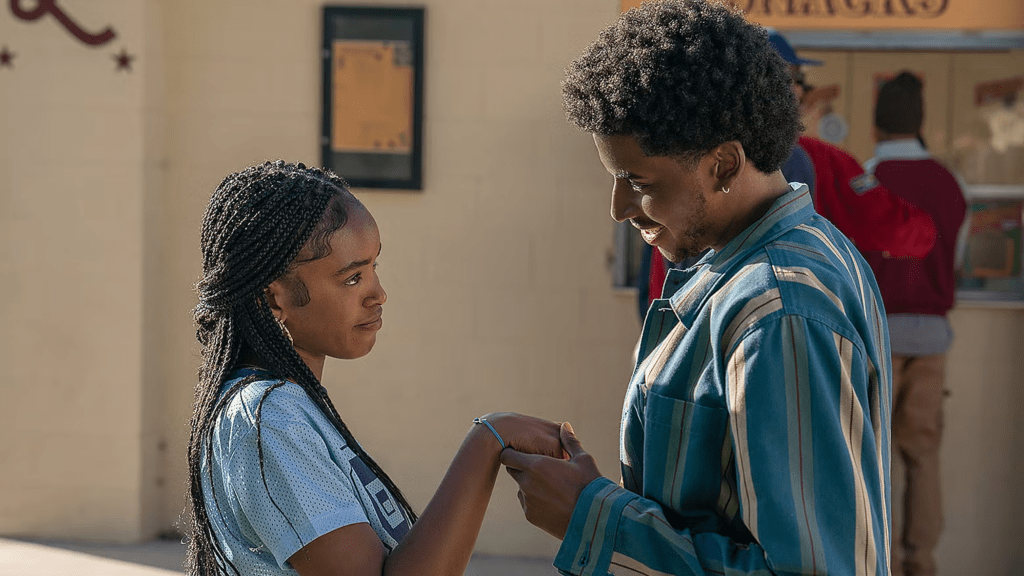
    Very few series have embodied a multi-dimensional exploration of healthy love as ‘Forever’ has. All American & Black-ish are among the few that match up, but Forever stands out as a love story of legendary quality that translates the arena of romantic love in the 2020s. Created by Mara Brock Akli, Forever is a raw story of teenage love that cuts through the vulnerability and honesty of a first love experience. The 8-episode masterpiece peels open Justin and Keisha’s hearts as we see them navigate an intense but freeing connection.

    It’s one of those objectively exceptional pieces of work that need no improvements – from the cinematography, the casting, the wardrobe, the storyline depth, all the way to the music – everything was done to near-perfection. The series boasts a 97% Rotten Tomatoes rating and 7.7/10 IMDb rating for good reason! Not only did I thoroughly enjoy the music chosen for this series, but it also got my creative juices flowing, and I re-imagined the soundtrack to suit my taste to perfection.

    Here are a few of my favourite scenes and themes, matched to some of my favourite songs πŸ™‚ Enjoy!

    Theme 1: Ghosting & Blocking as a communication currency

    For this theme, I dedicate Frank Ocean’s – Thinking about you.

    Many of us can relate to Keisha’s frustration in Episode 2 as she waited for what felt like an eternity to be texted back, after she had bared her soul and confessed her love (/interest) for Justin. We can also relate to Justin’s delay in responding due to ‘having a life’ that doesn’t orbit around the magnetic force of a love life. Within a communication and romantic culture that is riddled with anxiety, it’s difficult to grow a new connection when trust is traded based on tested sincerity. What constitutes “tried and tested sincerity” may differ from person to person, but usually it’s about who will play their cards openly first. Trusting someone with your heart or your truth is no easy task, and often, the occasional levers of power in ghosting or blocking will be pulled, but Frank Ocean’s ‘Thinking about you’ invites us into a child-like honesty, to admit thinking about someone & to tell them what it is we think about them. In doing this, it is a revolutionary act that does not cheat your heart out of a real chance at connection. Keisha and Justin learn this later on, but raw honesty and being patient with the other person as they figure their thoughts out is a key ingredient to making love work.

    Theme 2: You’ll Know it’s True Love When It Calls You Out

    For this theme, I dedicate Madison Ryann Ward’s “The Key”

    In a scene that’s dubbed one of the best TV scenes of 2025, Justin sits with his Dad discussing Keisha, who had traveled to a different city to follow her heart and to try win Justin back (Ep 5). The magic of this scene is not only in the beautiful display of masculinity modeled through a rare conversation among black men about feelings, love & emotions – part of the magic is in Justin and his dad sharing a moment of relatability in that, in the same way Justin has to be courageous in the face of a love that requires a depth of emotions, Eric (Justin’s Dad) had to overcome himself as well for Dawn (Justin’s Mom). Keisha and Justin’s love story wasn’t only beautiful to watch, but it was also an uncomfortable and triggering watch. A connection that began so innocently grew into a grandstanding force of transformational pressure, where both Keisha and Justin constantly demanded that the other step up in pursuit of the best versions of themselves. Just like Madison’s “The Key”, when love is really true (friendship/ romantic), it becomes the thing that unlocks the versions of you that you’ve been trying to access on your own.

    Theme 3: The sanctity of romantic love & why it is a legitimate dream/ambition

    For this theme, I dedicate Snoh Alegra’s “Sweet Tea”

    My favourite scene of the series is when Justin and Keisha run towards each other as they reconcile after having fought so hard for their love.. Snoh Alegra’s Sweet Tea not only fits because of the sweetness of the moment they shared, it fits because a romantic connection/ romantic love is undoubtedly one of the best things a human being can experience. In the age where singleness is on the rise and the value of true love has been shaved down to almost insignificance, the series stands in stark opposition to this in how Keisha and Justin are portrayed to be experiencing this love that sweeps right through their entire lives, showing us how they, and everyone around them is treating their relationship as a sort of dream come true or an ambition that has been achieved. The world treats the gentleness and vulnerability of being a true lover/yearner as something to be shunned or seen as a weakness. This is because the popular choice in modern romance would be to rather have a roster/options. Putting this modern view in contrast to historical displays of romantic desire where romance and love were seen as one of the worthiest experiences for a human being, think Bridgerton or Harriet Tubman’s love story in the biopic and the countless other movies on slavery where love was seen/used as the saving grace to sedate and/or offer fulfillment to people amidst the ‘hell’ they lived in. I think ‘Forever’ does a great job at treating romantic love with the sanctity and legitimacy of old. As Snoh Alegra puts it Keisha and Justin “felt so free, so surreal whenever they were with each other… it felt like they were dreaming” and we got to live their dream with them. ❀

    Have you watched Forever yet? What were your favourite scenes/ themes?

    xo

  • Where I Go When The Music Plays

    3–4 minutes

    Try, he said, handing me the paintbrush. I was looking at a blue dolphin drawing that I was meant to recreate. I had watched closely while he was making the painting and had seen that glow in his eyes that always greeted the glow in mine with a certain reverence – I saw that glow and the ease with which he could spill his heart onto paper with any colour, telling any story. I should have been paying attention to the painting itself, how to swirl the outline, the technique he used to make it look so real, instead of being enamoured with his soulfulness.

    And as if I was not already drowning in his eyes, distracted, Sishii’s Levity was like a strong flow of ocean waves, pulling me deeper into the centre of this whirlwind feeling that was working alongside this glass of wine to disorient me. The string arrangement of the song was threading the evening together so beautifully in my mind, lost in thought, I softly reflected on the many events that had to occur so I wouldn’t miss out on this young man’s brilliance. If I had not finished my semester test when I finished it on that day, I would not have met our mutual friend. If I had not decided on that Sunday to go visit the church I had been promising myself to visit over some months, I would not have had the chance to meet him and the endless other things that worked together for this butterfly effect to culminate into this third date.

    I particularly heard nothing he said when this song was playing, and if I was drowning before, Sishii’s voice was now the surfboard that was helping me ride the waves of this evening’s intensity. Was this the ‘meeting of souls’ feeling that those older and wiser spoke of? That “when you know, you know” moment was happening right now? Is this what it feels like to know? There aren’t any angel voices, but that’s fine because Sishii’s voice felt close enough to the sound I thought I’d hear when the angels sing “this is he, given to you by the heavens”.

    I had always believed in love at first sight, maybe not at first sight, but I had always believed it was possible for strangers to know quickly that they are meant to love each other. I never used to know how to articulate my reason for believing this, but one day I discovered a possible inspiration for an argument to make in this case. In Luke 1:41, it speaks of a moment between Elizabeth mother of John the Baptist & Mary mother of Jesus Christ: “When Elizabeth heard Mary’s greeting, her baby leaped in her womb; and Elizabeth was filled with the Holy Spirit and empowered by Him.” The leap is seen as a sign of divine recognition, showing that the unborn John the Baptist acknowledged the presence of Jesus, even before birth.”

    Through this, I understood that something in you can leap in divine recognition of someone standing before you who could be sent by God to love you. So was this possible that, after about 3 weeks, this was a leap of the souls recognizing each other? Side note: Can the other person tell exactly when you fell for them, and does it scare them?

    The truth is, None of this happened.

    There was no third date. No shared glass of wine. No young man glowing across the table from me.

    This night exists only where music plays.

    This is where music takes me.

    When a song like Levity plays, it doesn’t just make a sound that is pleasant; it creates a world within the walls of my mind, it’s directing a movie, telling me a story, a story that is dynamic. And while the lyrics stay the same, the interpretation and application of a song changes as the days of our lives change.

    One of my favourite niche music genres is cinematic music. I hope this song takes you somewhere beautiful as well when you listen.